Issue No. 174
Time: September 1, 2026, 15:00
Location: B-518 Lee Shau Kee Building of Science and Technology
Host: Prof. Xuefei Xu
Abstract:
Since Tully’s 1971 seminal paper of development of trajectory surface hopping method to simulate nonadiabatic processes of two electronic state system, using and developing nonadiabatic dynamics algorithms to study photochemical systems involve a couple of electronic states becomes an active and mature approach. However, many challenges remain, and one of the most difficult problems is how to simulate those systems with dense manifold of states. This is critical because the scientific attention is shifting from simulating single, isolated molecule in simple environment to condensed phase, to materials, to surface reaction, and to systems in complex environments. Therefore, it is critical to develop new methods to learn the surfaces of those coupled dense manifold of states and to properly perform the nonadiabatic simulation on those surfaces. In this talk, I will introduce the recent advances in this direction from our perspective. In the second part of the talk, I will present our recent development of a new approach to density functional theory: integral-feature density functional theory. By incorporating integral features into the neural-network architecture used to construct the functional, we demonstrated the state-of-the-art performance of our new functional, surpassing machine-learning functionals developed in recent years, including DM21 from Google and Skala-1.1 from Microsoft. I will discuss the central ideas behind this approach and show how its physically informed features lead to improved accuracy and generalizability across a broad range of chemical applications.
Introduction of speaker:
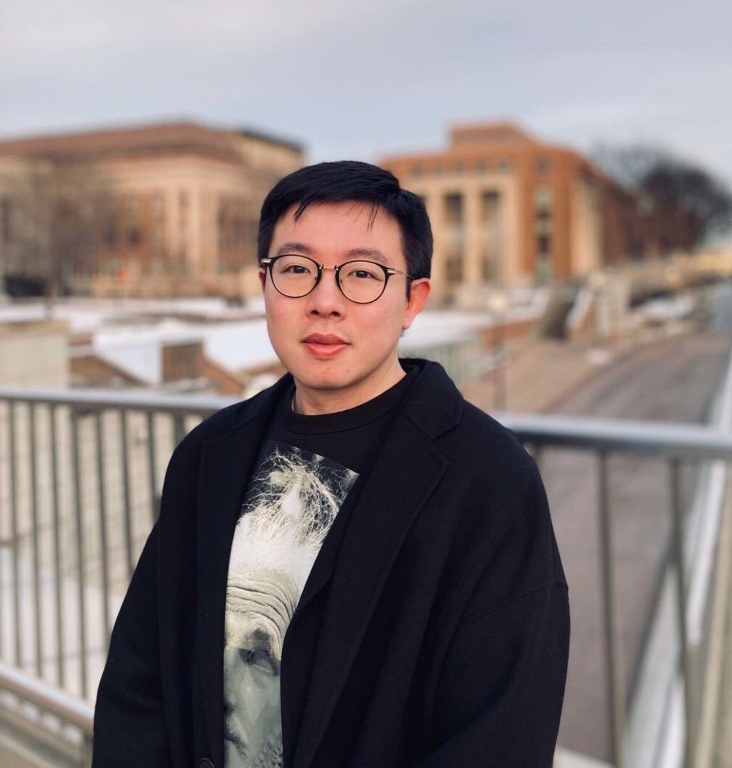
Yinan Shu is currently a research associate in Prof. Donald G. Truhlar’s group at University of Minnesota. He got his Ph.D. degree in Chemistry in 2016 at Michigan State University and B. Sc degree in both Chemistry and Biological Science at Wuhan University. His research area is Theoretical and Computational Chemistry. Specifically, he has been working on projects related to electronic structure theory, nonadiabatic dynamics, material science, chemical reactions, and machine learning. He has received 2020 ACS Phys Young Investigator Award (ACS Division of Physical Chemistry), 2020 Robin Hochstrasser Young Investigator Award (Chemical Physics, Elsevier), and 2021 Spring Wiley Computers in Chemistry Outstanding Postdoc Award (ACS Division of Computers in Chemistry).
审核:刘有晟、游小清