Recently, a study on a Jacobian-corrected minimum-mode-following hyperdynamics method by the research group led by Associate Professor Liang Zhang at the Center for Combustion Energy and the School of Vehicle and Mobility, Tsinghua University, was selected as an Editor’s Pick by The Journal of Chemical Physics. Entitled A Jacobian-Corrected Minimum-Mode Following Bias Potential for Hyperdynamics, the article has been accepted for publication in the journal. The Editor’s Pick designation is given to papers that the journal’s editors consider noteworthy. Selected articles are featured on the journal homepage and display an Editor’s Pick badge next to the title. This work extends ridge-based hyperdynamics from model potentials to realistic atomistic systems, with nearly dimension-independent acceleration and largely restored force-energy consistency.
Processes such as diffusion, defect migration, and surface reactions typically occur on timescales far longer than atomic vibrational periods. Conventional molecular dynamics can provide complete atomistic trajectories, but it often cannot sample these rare transition events within affordable simulation times. Hyperdynamics, an accelerated molecular dynamics method, introduces a bias potential inside a potential basin to promote escape from the current state. To preserve the correct statistical relationship among transition rates after acceleration, the bias potential must vanish near the basin boundary.
In hyperdynamics, the construction of the bias potential determines whether the accelerated dynamics preserves the correct transition statistics. Bond-Boost methods usually construct the bias potential from bond-length changes and local structural information, making them a representative class of local-bias approaches. As the dimensionality of an atomistic system increases, the region activated by local bond-length changes becomes relatively smaller, and local-information-based bias constructions can lose acceleration efficiency.
Minimum-mode following adopts a different strategy for bias construction. It determines the minimum-curvature direction from the Hessian eigenvector associated with the smallest eigenvalue. Starting from the current configuration, the method searches along this direction for the ridge separating neighboring potential basins and then constructs the bias potential from the energy of the ridge configuration. Compared with bias methods that rely on structural information near local minima, this ridge-based construction uses information from the basin boundary and can avoid the loss of acceleration efficiency in high-dimensional systems.
Existing hyperforce evaluations in minimum-mode-following hyperdynamics still involve approximations. In principle, the mapping from the current configuration to the ridge configuration should be described by a Jacobian matrix. Direct evaluation of this matrix generally requires higher-order derivatives of the potential energy surface and is therefore computationally expensive. Existing implementations approximate the Jacobian matrix by the identity matrix. This approximation can remain acceptable in low-dimensional model systems, but in atomistic systems with many mobile atoms the minimum-mode direction changes along the search path, leading to substantial inconsistency between the bias potential and the bias force and thereby affecting dynamical accuracy.
To address this problem, Liang Zhang’s research group revised the hyperforce evaluation in the minimum-mode-following method and proposed the Jacobian-corrected minimum-mode-following method. The method uses the sequence of minimum-mode vectors already obtained during the ridge search to construct a semi-analytic Jacobian correction, and it applies an orthogonal projection to remove the erroneous bias-force component along the reaction-coordinate direction. The bias potential is given by the energy difference between the ridge configuration and the current configuration and is capped by the maximum bias threshold, as shown below.

When the maximum bias threshold has not been reached, the gradient of the hyperdynamics potential is evaluated using the Jacobian-corrected ridge-gradient term with an additional orthogonal projection. Once the threshold is reached, the bias potential is constant and the gradient reduces to that of the original potential. The corresponding expression is shown below.

The corresponding hyperforce is Fh= −∇Vh. Here, r‡ denotes the ridge configuration obtained from the current configuration, Jr‡(r) is the Jacobian matrix of the mapping from the current configuration to the ridge configuration, and N is the local minimum-mode direction. The term I−NNT is the orthogonal projection operator, which removes the bias-force component along the reaction-coordinate direction. Because the Jacobian correction uses the minimum-mode sequence already available from the ridge search, it does not require additional force evaluations devoted to the Jacobian correction itself.
The group benchmarked the method using the diffusion of a single Cu adatom on the Cu(100) surface and compared conventional molecular dynamics, Bond-Boost, uncorrected minimum-mode following, and the Jacobian-corrected minimum-mode-following method. To examine the effect of system dimensionality, three models with different numbers of mobile atoms were constructed. In the first model, only the adatom was allowed to move. In the second model, the adatom and nearby Cu atoms in the top surface layer were mobile. In the third model, up to 201 atoms were mobile.
The results show that uncorrected minimum-mode following increasingly underestimates transition rates as the system size grows, revealing a theoretical deficiency. The Jacobian-corrected method remains closer to reference results from conventional molecular dynamics in all three models. In terms of acceleration efficiency, the boost factor of Bond-Boost decreases markedly as the number of mobile atoms increases, indicating a dimensionality-related limitation. Over the tested range, the boost factor of the Jacobian-corrected method is only weakly dependent on system size and remains high. Moreover, the method can use a larger maximum bias potential while preserving rate accuracy, further improving acceleration at low temperature.
This work improves the force evaluation of ridge-based hyperdynamics in high-dimensional atomistic systems. In combination with more efficient ridge-search algorithms, machine-learning potentials, or surrogate models, the Jacobian-corrected minimum-mode-following framework may provide a methodological basis for long-timescale simulations of surface diffusion, defect migration, and other transitions between metastable states. Applications to specific systems should still be validated with respect to the potential-energy model, metastable-state definition, and recrossing behavior.
Lixiang Qian from the Center for Combustion Energy and the School of Vehicle and Mobility, Tsinghua University, is the first author of the paper, and Liang Zhang is the corresponding author. This work was supported by the National Natural Science Foundation of China (Grant No. 22373055), the Tsinghua-Sinopec Green Chemical Joint Research Institute Program (Grant No. 224199), the Tsinghua University Dushi Research Program, and the Center of High-Performance Computing at Tsinghua University.
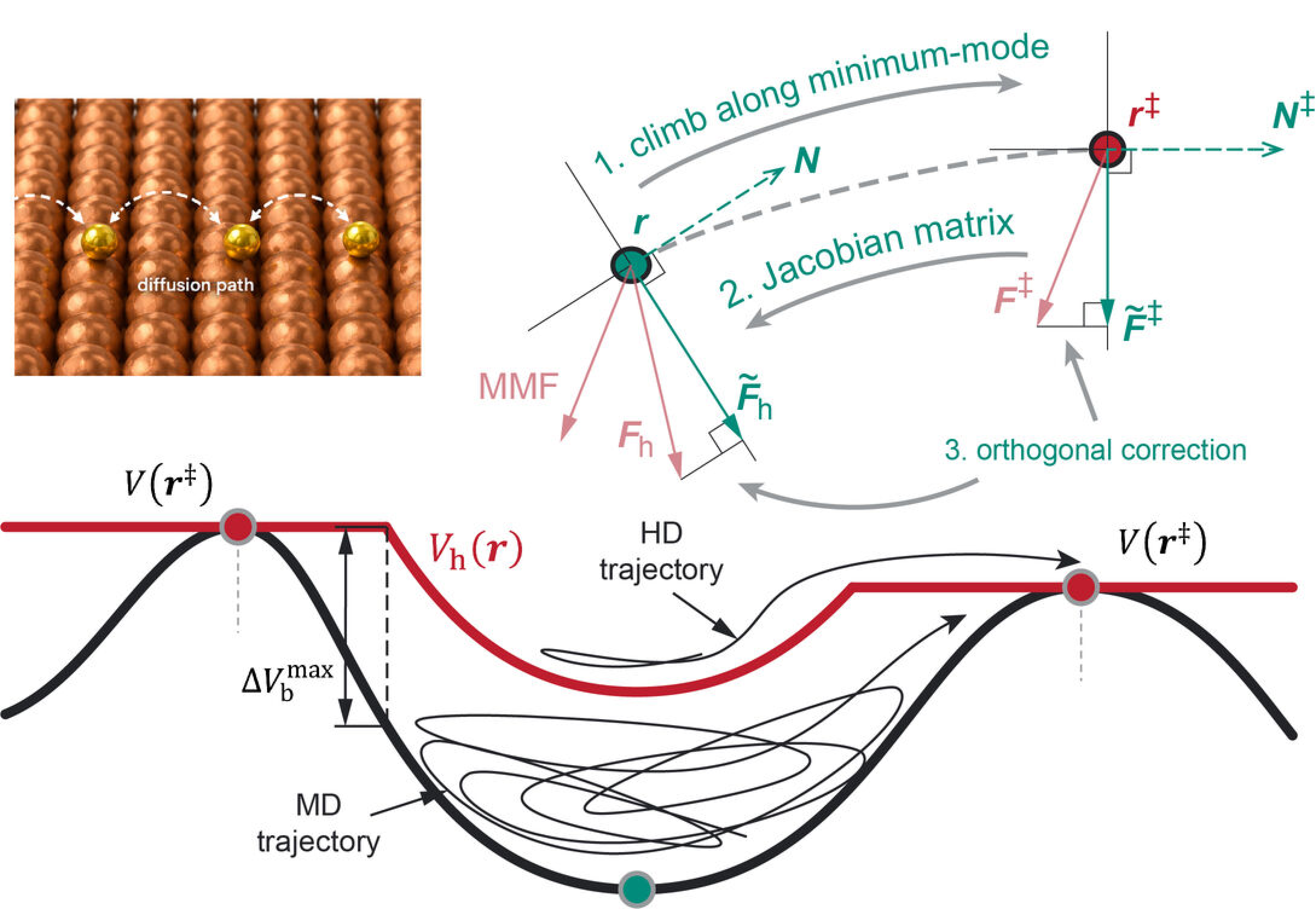
Figure. Schematic illustration of the J-MMF method. The method searches for transition ridges along the minimum-mode direction and corrects the bias force through a Jacobian correction and orthogonal projection, enabling accelerated rare-event simulations in high-dimensional atomistic systems.
Provided by: Liang Zhang's Group
Approved by: Yu Cheng Liu, Xiaoqing You